About
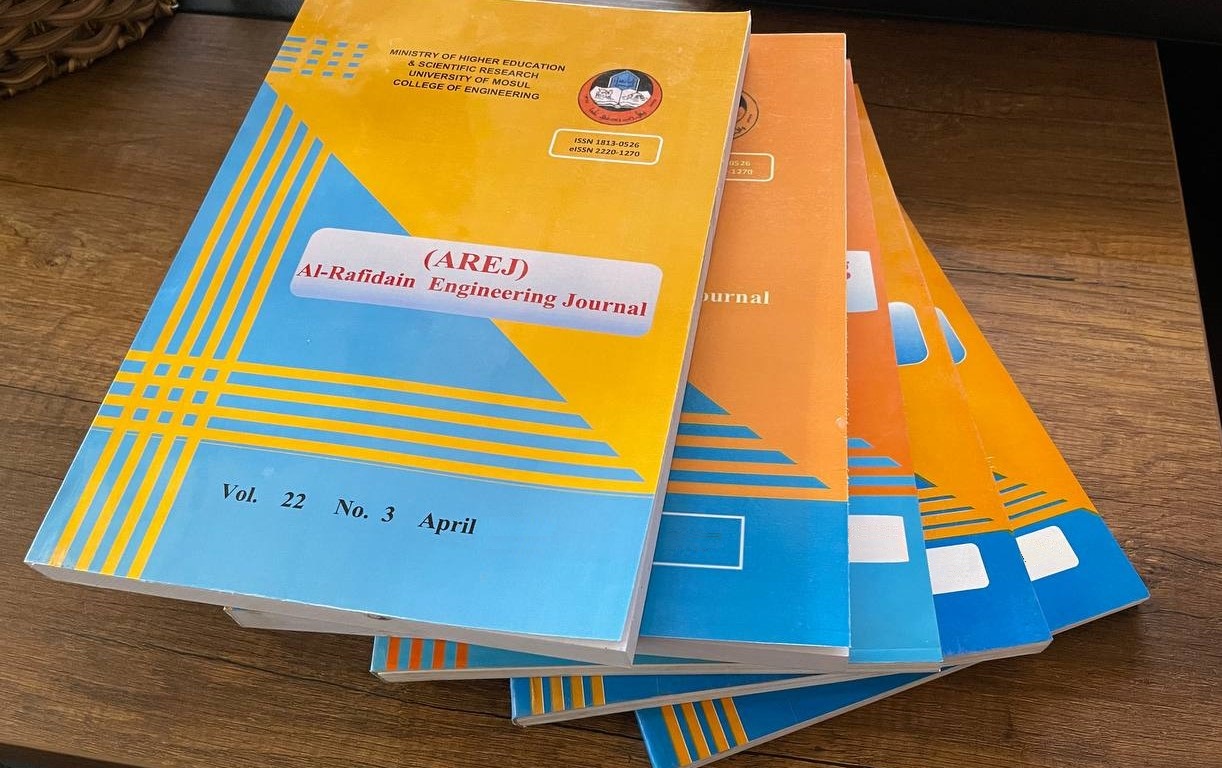
Al-Rafidain Engineering Journal (AREJ) is a scientific and open-access journal. AREJ belongs to the College of Engineering at the University of Mosul, Iraq. The first issue of AREJ was published in 1993. We are using iThenticate to prevent plagiarism and ensure our submitted manuscripts' originality. A double-blind peer-reviewing system is used to ensure the publication's quality.
The publication of AREJ sheds light on topics related to the disciplines of applied engineering, such as Civil, Electrical, Mechanical, Computer, Mechatronics, Architecture, Dams and Water Resources, and Environmental Engineering. Publishing under the license of Creative Commons Attribution 4.0 International (CC-BY). AREJ publishes original articles, review papers, and case reports in the field of applied engineering. This journal index into well-known world databases such as DOAJ, OAJI, Google Scholar, and IASJ. AREJ adopted a unique DOI number [10.33899/rengj] obtained for each article published.
The AREJ uses a double-blind peer-reviewing system to ensure the quality of the publication. All manuscripts should be submitted through our online manuscript management system. The author should first register in our system and then submit their manuscript. We will use iThenticate to check plagiarism before sending it to reviewers, who should be under 20%. We will notify corresponding authors about their manuscripts through our online system within one to two months.
AREJ publishes open-access articles, which means that all articles are available on the internet to all users immediately upon publication. All articles published in the AREJ are open-access and immediately available to read, download, and share. Articles published in the AREJ are under the terms of a Creative Commons license 4.0 (CC-By), which permits users to read, print, and download, or redistribute, translate, and download the article for text and data mining purposes, or reuse portions or extracts from the article in other works. The AREJ is committed to upholding Publication Ethics (COPE) and obligates the authors to avoid plagiarism and illegal citations.
As an open-access journal, publishing an article in this journal requires an Article Processing Charge (APC) that will be billed to the submitting author following acceptance. There are no other fees (for example, submission, page, or color charges). The Article Processing Charge for the journal is 250.000 IQD for Iraqi authors inside Iraq. The Article Processing Charge is FREE for international authors.
The AREJ stopped reviewing and publishing articles from 2015 (stopped after publishing volume 23, issue 5, year 2015) to 2019 (reactivated from volume 24, issue 1, year 2019) during ISIS occupying Mosul city for three years after the military liberation operation conducted by Iraqi forces to liberate Mosul city. The AREJ has been receiving and publishing articles since 2019.
Previously, the journal published articles in Arabic and English, but in 2023, the publishing was turned to English only with Arabic abstracts.
ISSN: 1813-0526 (Print); 2220-1270 (Online)
Al-Rafidain Engineering Journal (AREJ) is a signatory to the Sustainable Development Goals (SDG) Publishers Compact. AREJ supports the following U.N. Sustainable Development Goals (SDG) :
1- Zero Hunger: End hunger, achieve food security, improve nutrition, and promote sustainable agriculture.
2- Quality Education: Ensure inclusive and equitable quality education and promote lifelong learning opportunities for all.
3- Clean Water: Ensure the availability and sustainable management of water and sanitation for all.
4- Affordable and clean energy: Ensure access to affordable, reliable, sustainable, and modern energy for all.
5- Industry, innovation, and infrastructure: Build resilient infrastructure, promote inclusive and sustainable industrialization, and foster innovation.
6- Sustainable cities and communities: Make cities and human settlements inclusive, safe, resilient, and sustainable.
Current Issue
Vol. 31 No. 3 (2026): Volume 31 Issue 3
Volume 31 Issue 3
Published: 2026-09-01
Contents
Engineering (Miscellaneous): Electrical and Electronics Engineering
Influence of EV Charging Stations on the Performances of Three-Phase Distribution Transformers in Residential Grids
Hiba N. Al-Kaoaz, Omar Sh. Al-Yozbaky
Electric vehicle charging stations significantly impact the performance of three-phase (11/0.4 kV) distribution transformers, as unbalanced and variable loads lead to higher temperatures and...
DOI: 10.33899/arej.v31i3.64951
Feature-Driven Electrical Load Prediction Using Interpretable Machine Learning Models and Meta-Ensemble Learning: Evidence from Mosul’s 132 kV Grid Energy
Anas Thamer Mustafa, Omar Sharaf Al-Deen Al-Yozbaky
Accurate forecasting of electrical load plays a critical role in enhancing the efficiency, reliability, and operational planning of power distribution systems—particularly in regions facing...
DOI: 10.33899/arej.v31i3.64954
Engineering (Miscellaneous): Civil Engineering
Evaluating the Mechanical and Durability Performance of Carbon-Sulfur Mix Asphalt Modified with SBS and SZ additives
A. I. Al-Hadidy, Amani A. Al-Ttayiy
The rising quantities of the blowdown (carbon-sulfur) hydrocarbon waste generated in the production of sulfur posed challenges to the environment in Iraq. This research paper explored the...
DOI: 10.33899/arej.v31i3.64952
Computer Engineering > Network Security and Cybersecurity
Stacked Ensemble Learning for Effective Flow-Based Intrusion Detection System
Omar Abdulmunem Ibrahim Aldabbagh
As developing cyber threats complexity and sophistication, traditional Network Intrusion Detection Systems (NIDS) face difficulties in detecting attacks within an acceptable time. For these...
DOI: 10.33899/arej.v31i3.64955
Machine Learning Multi-Class Intrusion DetectionSystem Using Embedded Feature Selection and Multi-Level Hierarchy Classification
Tarfa Hamed, Dr. Kremer
In recent years, network security has attracted significant research attention due to the growing frequency of attacks on computer networks. Among existing solutions, “Network Intrusion...
DOI: 10.33899/k610ap05
Computer Engineering > Artificial Intelligence
Lightweight Quantized CNN for Real-Time Histopathological Diagnosis on Edge Devices in Digital Pathology
Sohaib R. Awad, Amer T. Ali, Amar I. Daood, Ahmed M. Alkababji
There is a goal to develop a fundamental deep learning system for histopathological image categorization, which operates in real-time while keeping a lightweight design to facilitate better...
DOI: 10.33899/arej.v31i3.64953
Computer Engineering > Computer Networks
LR-Aided Linear Detection Combined with Adaptive QRD-M in MIMO-OFDM Systems
Mar Mar Lwin, Mohd Fadzli Mohd Salleh, Salah A. Alabady
This paper proposes an LR-aided adaptive QRD-M detector for complexity reduction in MIMO-OFDM systems. The proposed approach integrates lattice-reduction preprocessing with an adaptive candidate...
DOI: 10.33899/arej.v31i3.61893